Introduction
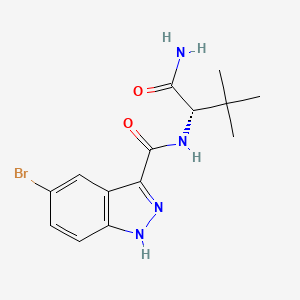
ADB-5Br-INACA (N-[(2S)-1-Amino-3,3-dimethyl-1-oxobutan-2-yl]-5-bromo-1H-indazole-3-carboxamide, C₁₄H₁₇BrN₄O₂, MW 353.21) is a synthetic cannabinoid receptor ligand belonging to the indazole-3-carboxamide structural class. This compound features a 5-bromo substitution on the indazole core and an ADB (1-amino-3,3-dimethyl-1-oxobutan-2-yl) tail moiety, distinguishing it from the analogous MDMB-5Br-INACA which carries a methyl ester terminal group.
Structural Overview
The molecular architecture of ADB-5Br-INACA comprises three key pharmacophoric domains:
- Indazole Core (Head): A 5-bromo-1H-indazole heterocycle (CAS 1077-94-7), providing the central scaffold for receptor interaction.
- Carboxamide Linker: An amide bridge connecting the indazole C3 position to the tail moiety, critical for hydrogen bonding with CB₁/CB₂ receptors.
- ADB Tail: A chiral (2S)-1-amino-3,3-dimethyl-1-oxobutan-2-yl substituent, featuring a terminal primary amide (CONH₂) and a tert-butyl group, conferring metabolic stability.
Physicochemical Properties
| Property | Value |
|---|---|
| IUPAC Name | N-[(2S)-1-Amino-3,3-dimethyl-1-oxobutan-2-yl]-5-bromo-1H-indazole-3-carboxamide |
| Molecular Formula | C₁₄H₁₇BrN₄O₂ |
| Molecular Weight | 353.21 g/mol |
| InChI Key | AJGASUCDTSLMNP-LLVKDONJSA-N |
| SMILES | O=C(c1n[nH]c2c1cc(Br)cc2)N[C@@H](C(C)(C)C)C(=O)N |
| Chirality | (S) configuration at the tail α-carbon |
Structural Comparison: ADB vs MDMB Tail
A critical structure-activity relationship (SAR) distinction exists between ADB-5Br-INACA and its close analogue MDMB-5Br-INACA. The ADB series terminates in a primary amide (CONH₂), while the MDMB series carries a methyl ester (COOCH₃). This difference profoundly impacts:
- Metabolic stability: The ADB amide is more resistant to esterase-mediated hydrolysis compared to the MDMB ester.
- Polarity and LogP: The amide tail increases hydrogen-bond donor capacity, slightly reducing LogP relative to the ester variant.
- Receptor binding kinetics: The altered hydrogen-bonding profile may modulate residence time at CB₁/CB₂ receptors.
Analytical Characterization
The CFSRE (Center for Forensic Science Research & Education) has published a comprehensive analytical profile of ADB-5Br-INACA, including:
- GC-MS: Electron ionization mass spectrum showing diagnostic fragment ions consistent with the 5-bromoindazole-3-carboxamide core.
- LC-QTOF-MS: High-resolution mass spectrometry providing accurate mass confirmation of the protonated molecular ion [M+H]⁺ at m/z 354.06.
- NMR Spectroscopy: ¹H and ¹³C NMR assignments confirming the substitution pattern and (S)-stereochemistry.
- FTIR: Characteristic carbonyl stretching frequencies for the carboxamide (∼1650 cm⁻¹) and primary amide (∼1680 cm⁻¹).
Synthetic Considerations
The synthesis of ADB-5Br-INACA follows a convergent approach analogous to other indazole-3-carboxamide synthetic cannabinoids:
- Core Preparation: 5-Bromo-1H-indazole-3-carboxylic acid (CAS 1077-94-7) is activated as the acid chloride or via a coupling reagent (e.g., HATU, EDCI).
- Amide Coupling: The activated indazole acid is coupled with (2S)-1-amino-3,3-dimethyl-1-oxobutan-2-amine (ADB amine) under standard peptide coupling conditions.
- Purification: Flash column chromatography or preparative HPLC affords the target compound in high purity (>98%).
Regulatory and Forensic Context
ADB-5Br-INACA has been documented in the Aipsin (Analytical Profiles for Intoxicating Substances) monograph series (Issues 26 and 39, 2022–2023) and in the Project Response program (report HIFS-026) as an emerging synthetic cannabinoid of forensic interest. Its structural similarity to scheduled indazole-3-carboxamide cannabinoids places it within the scope of generic controlled substance analogues legislation in several jurisdictions.
Availability
This compound and its synthetic intermediates, including 5-bromo-1H-indazole-3-carboxylic acid (CAS 1077-94-7), are available for research purposes. Contact us for pricing and specifications.
Telegram: @vv998800